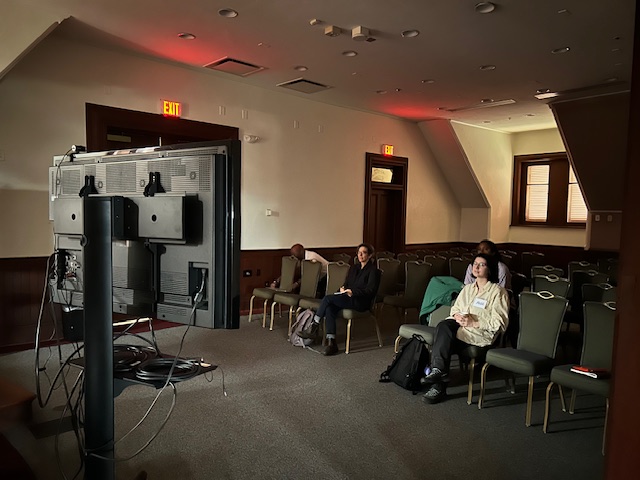
Small groups engaging with this video yield stories, tears, and the deep connections that are themes and practices of Please Hold. This inter-generational screening comprised some of the scholars from the Knowledge of AIDS Network who lost uncountable friends and other graduate students who were born after all these losses. What resulted is not seen above: commitments to memory, AIDS activism, and each other. Here are two audience-members’ reflections:
—Please Hold is a meditation on the ongoingness of collaboration with the living and dead across time and space. The film itself becomes a holding environment for the many legacies of AIDS that haunt and move us in the present. — Lisa Diedrich, Professor of Women’s, Gender, and Sexuality Studies, SUNY Stonybrook
—Please Hold granted me permission to consider the cruciality of memory in AIDS work. For me, it is not merely that we must remember what happened in the past. Rather, memory serves as a gateway into past moments that dutifully shape our present lives, actions, and essentially “why we do what we do” as AIDS workers. — Jarrett L. Joubert, Ph.D. Candidate, Biology and Society | History and Philosophy of Science (HPS), Arizona State University
–What I have found myself thinking most about is what it means to hold something. Video holds us–it holds people and spaces in a specific moment, regardless of how time has changed them. It also holds us as viewers to watch and to return to these specific moments. This can be uncomfortable and painful as much as it is a welcome reminder of a person or place that has passed. I appreciated the video for how it sits with what is painful about return, and its suspicions of the nostalgia of memory. The structural reasons that make Jim and Juanita’s deaths painful still exist, and will continue to lead to loss for many other people. Please Hold helps us think between the specificity of grief to a relationship and the people in it, and the recognition that we share this pain across time and circumstance.
The core of what made me so emotional watching the film is the role of physical objects in grief. These are the tangible things we can hold after a loved one has passed. And, of course, there is so much holding and moving of stuff when a person passes! The cleaning out of a loved one’s room or home, or the removal of one’s belongings from a hospital room after they pass. The scenes of your and Jim’s apartment, and of Juanita’s hospital room brought this up for me. I tend to hoard objects from people I have lost (my family still mails me “junk” from my grandfather, aunt, great-grandmother as they find them for me to keep). I was affected by how you and your interlocutors spoke about the objects of loved ones in your lives–the sweater and the scarf. I am not sure I hold onto things as a static representative of this person’s memory, but a way to feel like they continue to live and change with me. Objects also change over from us holding them, they wear down, grow older, acquire new bumps and bruises.
I was born the same year that HAART went into widespread use. Despite the general framing that I have never experienced the “crisis” of AIDS, it has been part of my entire life, across industries and changes in care and conversation. Though it can feel embarrassing or out-of-touch to feel emotional in response to grief I did not experience, I am trying to follow that emotion for what it is telling me. What I have learned from a life in proximity to AIDS is what it means to grieve incalculable loss. The losses were never just to a single virus, but to the entangled neglect of racism, xenophobia, homophobia, and misogyny as the limits to accessing life. I am thankful to watching Please Hold with you and our other KOA fellows for the rare chance to feel grief together, even if each of our griefs brought us back to different times, places, and peoples. –Maile Young, Department of Bioethics and Health Humanities, University of Texas Medical Branc